
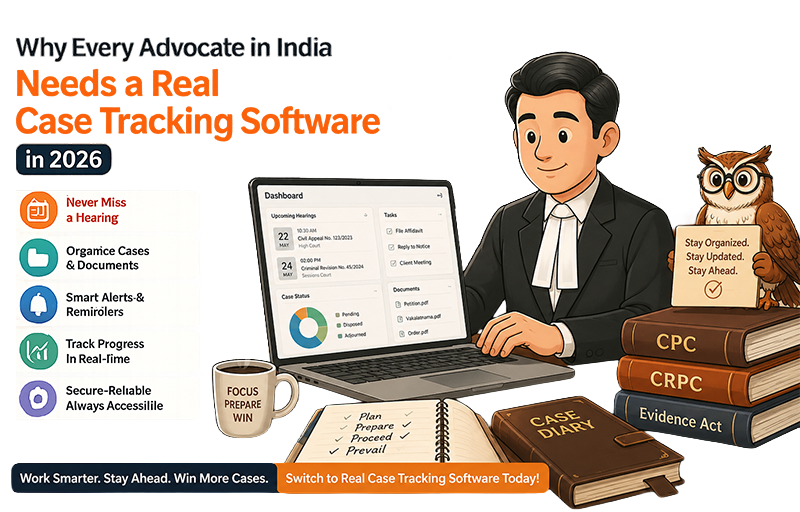
Why Every Advocate in India Needs a Real Case Tracking Software in 2026

Why Every Advocate in India Needs a Real Case Tracking Software in 2026

After two decades of building technology platforms, one pattern stands out: even the sharpest professionals are held back by poor infrastructure. Indian legal practice reflects this gap clearly, making case tracking software for advocates a necessity, not a luxury.  

I have spent over twenty years working in SaaS and AI, helping organizations move from manual processes to systems that scale. When I started looking at the legal profession in India, I expected to find some technology adoption challenges. What I did not expect was how fundamental the gap was.

Advocates manage 40 to 80 active matters on a combination of physical diaries, WhatsApp groups, and memory. In 2026, when a small retail business in any Indian city is running inventory, billing and customer communication through integrated software, most law chambers are still tracking court dates by hand. This is not criticism. It is an observation about tools. The right case tracking software has simply not existed for Indian advocates in a form that fits how they work. That is the gap LawVyn is being built to close.

What I see when I look at a typical Indian law chamber

Earlier this year I spent time speaking with advocates across Hyderabad, Mumbai and Delhi. Chambers running 40, 60, sometimes 80 active matters. Senior advocates with deep expertise in civil litigation, commercial disputes, and family law. Every single one of them was managing their practice on a system that would be recognizable to a lawyer from 1995.

I am not exaggerating. One advocate in Hyderabad showed me a WhatsApp group titled ‘Hearings This Week’ with 23 members. Another had a spreadsheet tracking 64 active matters that he manually updated every Sunday evening. A third told me she had missed a filing deadline three months ago because the physical file was with a junior who did not flag the date.

These are not careless people. They are highly capable professionals operating without the right infrastructure. In any other industry I have worked in, we would call this systems problem, not a people problem.

Real scenario (composite field conversations): Advocate Mehta manages 58 active matters across two courts. Every Monday he spends 90 minutes going through each file, updating a diary, and texting hearing dates to clients individually. On the third Monday of last month, he missed updating one matter. The client showed up to a rescheduled hearing that Mehta had not yet tracked. The relationship survived, but the trust took a hit that took weeks to rebuild.

What case tracking software does, practically

The term case tracking software gets used loosely, so let me be specific about what it means in practice for an advocate workflow.

It’s most useful; a case tracking system does three things well. First, it holds every active matter in one place with all its associated information. Second, it removes human dependency from deadline and hearing management by automating reminders now that a date is logged. Third, it gives every member of the team full context on any matter at any point, so information does not live only in the senior advocate’s head.

This last point is the one most practice underestimated. When context lives with one person, that person cannot take leave without the practice slowing down. They cannot hand a matter to a junior without a 45-minute briefing. They become bottlenecks because the system made them the system.

90 min 

average time spent weekly on manual case status updates per advocate 

1 in 5 

client complaints in small firms linked to missed or delayed communications 

3x 

faster matter handover when case data is structured and centralised 

 
Why most generic tools fail Indian advocates
Over my career I have helped companies in finance, healthcare, and logistics move from spreadsheets to structured software. The mistake I see most often is organizations buying tools that were built for a different context and trying to force-fit them.

This is exactly what happens when Indian advocates try international legal software. Tools built for law firms in the United States or the United Kingdom do not understand vakalatnamas. They are not structured around cause list management or the way matters move through district courts and high courts in India. The terminology is wrong. The workflow assumptions are wrong. And so, the tool gets abandoned within three months, and the diary comes back out.

I saw this pattern play out at a mid-size firm in Bengaluru last year. They invested in a well-reviewed international case management platform. Within six weeks, five of the seven advocates had stopped using it for daily tracking. The reason was not resistance to technology. The reason was that the tool made their actual workflow harder, not easier.

A case tracking tool is only as good as it fits the actual workflow. A tool that requires constant workarounds gets abandoned. A tool that disappears into the background and handles what it should is one that people actually use.

What the right case tracking software should do for your practice

Based on what I have seen both from a technology standpoint and from speaking directly with practicing advocates, the checklist is not complicated.

1. Single view of all active matters: with documents, dates, client information, and team assignments linked to each case. Not six different tabs across three tools.

2. Automated hearing and deadline reminders: that go to the advocate and the client at the moment a date is logged. Not dependent on anyone remembering to set up a reminder separately.

3. AI-assisted drafting: for standard documents so that legal notices, demand letters, and agreements are generated quickly from a template, not recreated from scratch every time.

4. Billing that runs in the background: tracking fees as work happens so that month-end reconciliation is already done rather than requiring a separate manual effort.

5. Built for Indian practice: meaning it understands the structure of Indian courts, the terminology advocates use, and the way matters move through the system here.


Where
LawVyn fits into this

LawVyn is being built as an AI-native case management platform specifically for Indian advocates and law firms. When I joined the LawVyn team as an advisor, the thing that stood out most to me was the specificity of the problem being solved. This is not a generic SaaS product with legal skin. It is a platform being shaped through direct conversations with practicing advocates about what their actual workflow requires.

The core of what LawVyn is building maps directly onto that checklist above. Case tracking that gives every matter a structured digital home from the first day. Hearing reminders that go out automatically. AI drafting that brings the time on standard documents from an hour to minutes. Billing that reflects work as it is done rather than as it is remembered at month end. 

From a technology standpoint, the architecture is also sound. AI-native from the ground up means the intelligence is built into the workflow rather than bolted on after the fact. That distinction matters more than most people realize. When AI is integrated into the core of a system rather than added as a feature layer, the output is more consistent and the learning loop is faster.

A practical starting point for any advocate

My recommendation to any advocate looking at case tracking software in 2026 is to start with one question: does this tool reduce the number of things I have to remember, or does it add to them?

A tool that requires you to update it manually, remember to log things separately, or cross-reference between it and a diary is not a solution. It is a second system. The right case tracking software should make the manual effort unnecessary, not digitize it.

If you are looking at LawVyn, the platform is still being shaped, and the team is actively speaking with practicing advocates. The advocates are ready. The expertise is there. What has been missing is the infrastructure to match it. Explore more at lawvyn.ai.

Scroll to Top